 | ||
have ‘step stops’ carving at the ends. These were in fashion in the early 1500s, which put the house around the end of
the reign of Henry VIII - the Tudor period. Hence the naming of the Tudor and
Oak Suites.
 | ||
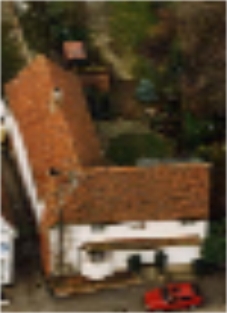
As can be seen from the photo, the building is L-shaped and was, up to around
1900, three small houses (referred to in old documents as tenements). In early
days it was common for quite large families to live in
‘one up, one down’ tenements and remnants of straw from the mattresses have been found.
Over the years the original wattle and daub infill between the oak wall beams
has been replaced by modern materials, although some of the original can be
seen on some internal walls. Likewise, brick may not have been available when
the building was put up and it is possible that smoke was carried out via daub
stacks through a thatched roof. Light and ventilation (to clear the smoke!) was
by glass-less mullion windows with sliding shutters (wind-doors) and the
diamond holes and shutter grooves are clearly visible above several of the
modern windows.
One still has the original mullions. Candle burns are clearly visible around the
wall beams in the Oak Suite.
In around 1960 the building is recorded as two houses - Church View and Hill
Cottage.
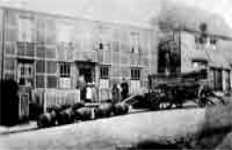 | ||
This picture shows the house (at the right with 3 front doors) and the Red Lion
Inn, now a garage and filling station.